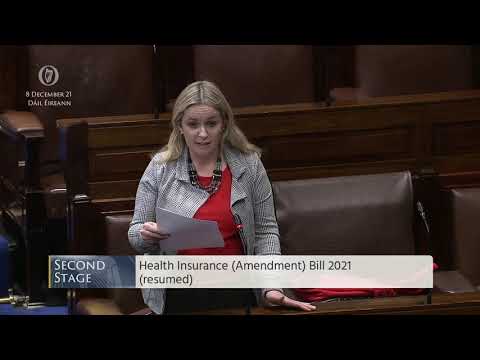
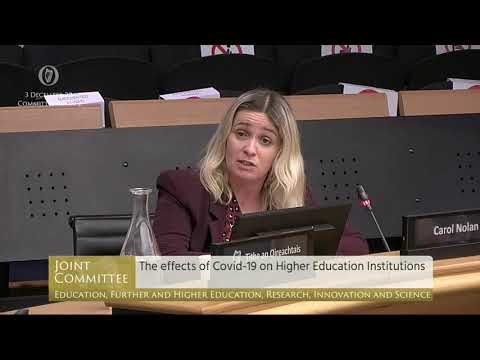
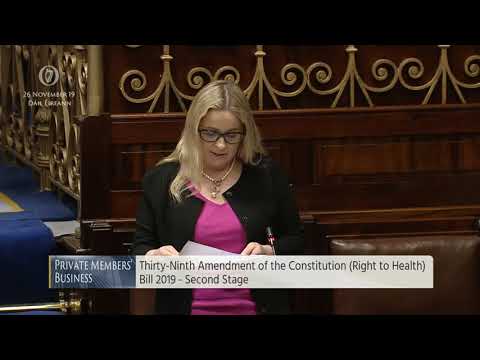
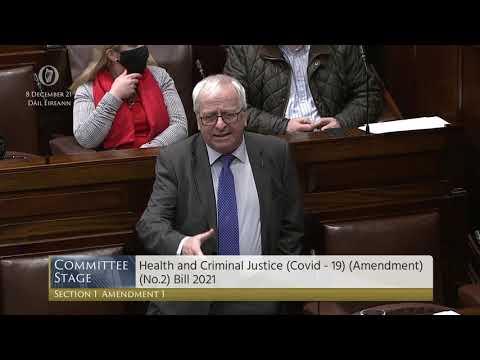
Carol Nolan criticises health insurers, calls for risk equalisation
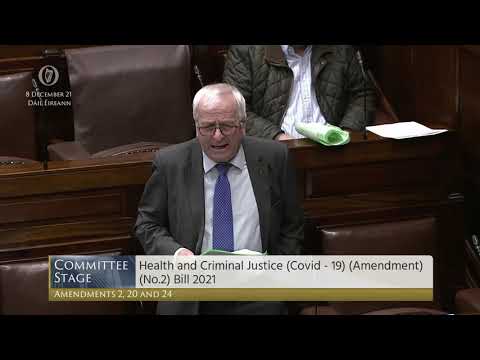
Carol Nolan spoke about a bill to introduce a risk equalisation mechanism for the private health insurance market and reductions in stamp duty on health insurance contracts. She welcomed the stamp duty cuts as belated and warned that without stronger safeguards the market will remain unaffordable and unfair to older and less healthy people.
Bill provisions
The bill seeks to provide a risk equalisation mechanism to support the sustainability of the private health insurance market while keeping policies affordable. It also reduces stamp duty on advanced contracts to 406 euro (a decrease of 43 euro) and on non-advanced contracts to 122 euro (a decrease of 35 euro).
Profit benchmark concerns
Section 4 amends section 7f of the Principal Act to change the benchmark for a reasonable profit used to assess whether an insurer has been overcompensated by the scheme. The speaker questioned what determines a reasonable profit and raised concerns about transparency in how insurers set and settle costs.
Market behaviour and COVID
The speech criticised insurer responses during COVID, noting it took High Court action to make insurers honour some policies and arguing insurers should have acted more fairly towards businesses and traders. The speaker also referenced the European Commission's preliminary view that Insurance Ireland breached EU antitrust rules in the motor insurance market as indicative of broader competition concerns.
Risk equalisation and consumer impact
Citing a Health Insurance Authority consultation in January, the speaker warned that in a community-rated market without a robust risk equalisation scheme, insurers with lower-risk profiles become more profitable and are incentivised to engage in risk selection and market segmentation. The central argument was that reforms are needed so everyone who needs or wants comprehensive health insurance can access it fairly.
We publish thousands of recordings to make Irish politics transparent and resistant to manipulation. Spotted an error? Report it — together we are building a reliable archive of Irish politics.
Minister, I am happy to speak briefly on this very important issue here this evening. The bill, as we know, seeks to provide a risk equalisation mechanism for ongoing sustainability of the private health insurance market, while also maintaining health insurance policies at an affordable price. It will also provide for a reduction in stamp duty levies on advanced health insurance contracts, which will decrease from 2021 to 406 euro. that is a decrease of 43 euro. And on non-advanced health insurance contracts, which will decrease from 2021 to 122 euro, a decrease of 35 euro. That is certainly welcome, but it is also a belated action. If partial recognition that prices for health insurance are simply astronomical at this point, and significantly out of the reach of so many people, especially those with chronic or long-term health conditions, especially those with chronic or long-term health conditions or indeed large families, I note that section 4 of the bill before us amends section 7f of the Principle Act by that it deals with the benchmark for reasonable profit and that this section is being amended for the purposes of assessing if an insurer has been overcompensated by the scheme. What is the entire debate that we have to address, Minister? What is it exactly that determines a reasonable profit and how far may a health insurance company go in settling costs? Clearly, it is the case that in this area, just like motor vehicle insurance or business insurance, we have a sector that is not always as transparent or open to public scrutiny as it should be. We have all seen how insurers responded to COVID and indeed the forced closure of SMEs and local traders. It took high court action to challenge the insurance to make good on policies that people had paid long and hard into. And that should not have happened. It should not have been the case. I felt, and I did raise this issue here on behalf of businesses, that the insurance companies should have been fairer and more reasonable. Some years ago, the European Commission itself informed Insurance Ireland, which is the Association of Irish Insurers, of its preliminary view that it breached EU antitrust rules by restricting competition in the Irish motor vehicle insurance market. Many people absolutely have the sense that there is a similar level of market restriction in terms of health insurance. The government's position is that our community-rated health insurance market means that the cost of health care insurance is shared across all members of the market and that, in general, with certain exemptions, everyone can buy the same policy at the same price. Insurers cannot alter their prices based on an individual's current or potential health status. But this is a regulatory version of wishful thinking. In the consultation conducted by the Health Insurance Authority in January of this year, it was recognised that in a community-rated market without a robust risk equalisation scheme, insurers with lower risk profiles will tend to be more profitable, all else being equal. As a result, in the absence of a robust RES, insurers will be incentivised to do the following. Design products so that they are not attractive to older and less healthy customers, which, as we know, is called risk selection. And segment their customer base by age or health status so that older and less healthy people pay more for insurance or market segmentation. We need to ensure that insurers are not allowed to engage in such practices, and that all people who want it can afford a different level of comprehensive health insurance. Really, it is about making sure that there is fairness for everybody and that everybody who needs health insurance, and indeed who wants health insurance, can avail of it in a fair and just manner. Thank you. Thank you.
Thank you for downloading 🙏
If you publish this material on social media, we would be very grateful if you tagged VideoParliament. It helps us reach more people and keep building a transparent archive of Irish politics.