

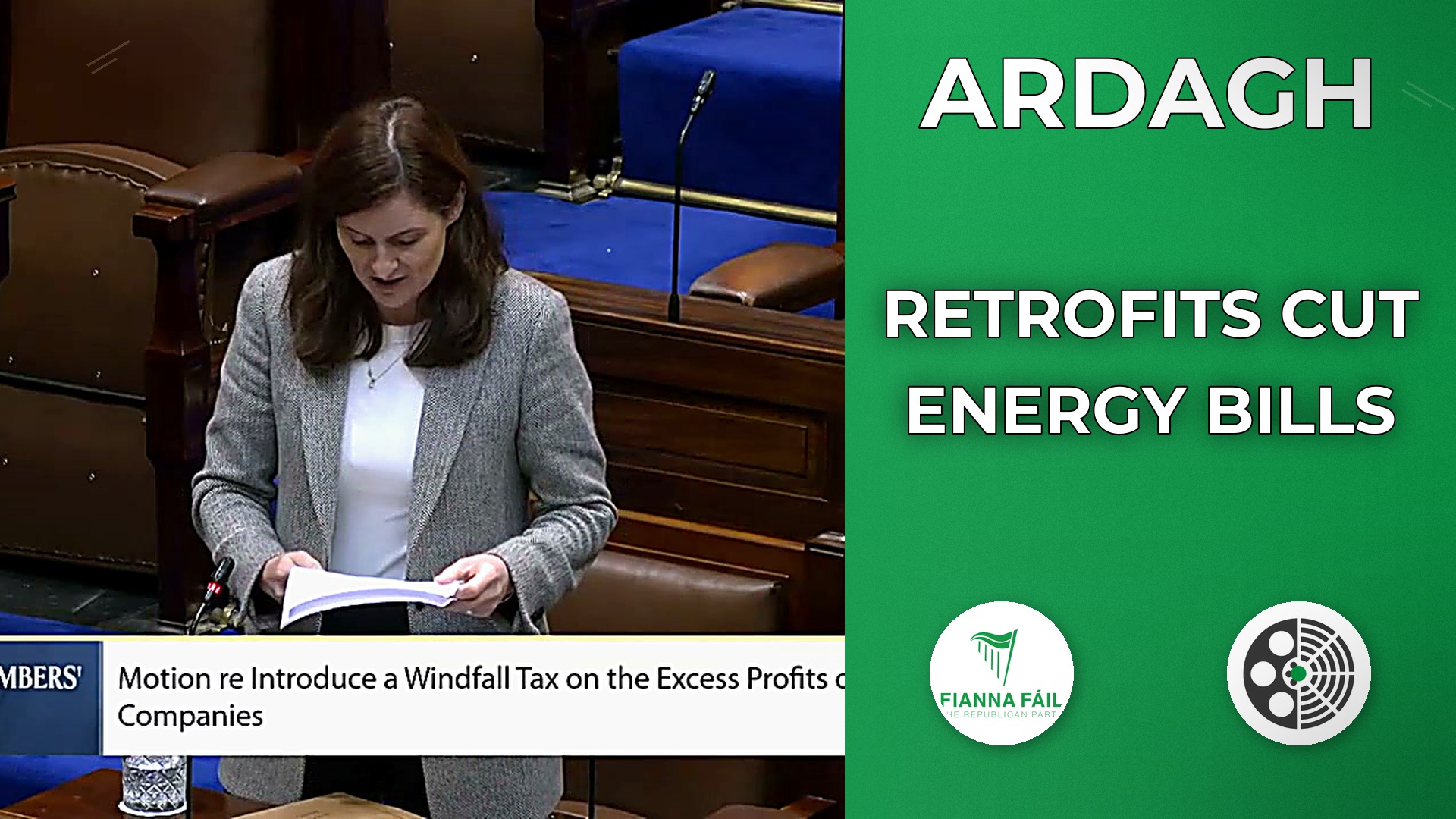


Catherine Ardagh defends Government response to energy costs
Catherine Ardagh set out the Government’s response to the Social Democrats’ motion on energy company profits during an Oireachtas debate. She said the Government would reject the motion and proposed a counter-motion, while pointing to existing supports and longer-term investment to ease energy costs and reduce reliance on fossil fuels.
Ardagh cited more than €1.4 billion in fuel supports, Budget 2026 measures on gas and electricity bills, and enhanced fuel allowance payments. She also highlighted supplier hardship supports and the Department of Social Protection’s additional needs payment for households struggling with fuel bills.
The Government’s approach, she argued, includes expanding home energy upgrades and renewable energy. Ardagh referred to a €640 million allocation for residential and community grant schemes, new retrofit grants and increased applications for home energy upgrades and solar PV. She said reducing dependence on fossil fuels was the best long-term way to protect consumers from volatile energy prices.
The National Energy Affordability Task Force is preparing an Energy Affordability Action Plan, which is due to go to Government in the coming weeks. Ardagh said the plan would consider measures such as a market revenue cap, and that Ireland would engage with EU proposals for a potential windfall tax or levy on energy companies. She said coordinated EU action was preferable given the interconnected energy markets.
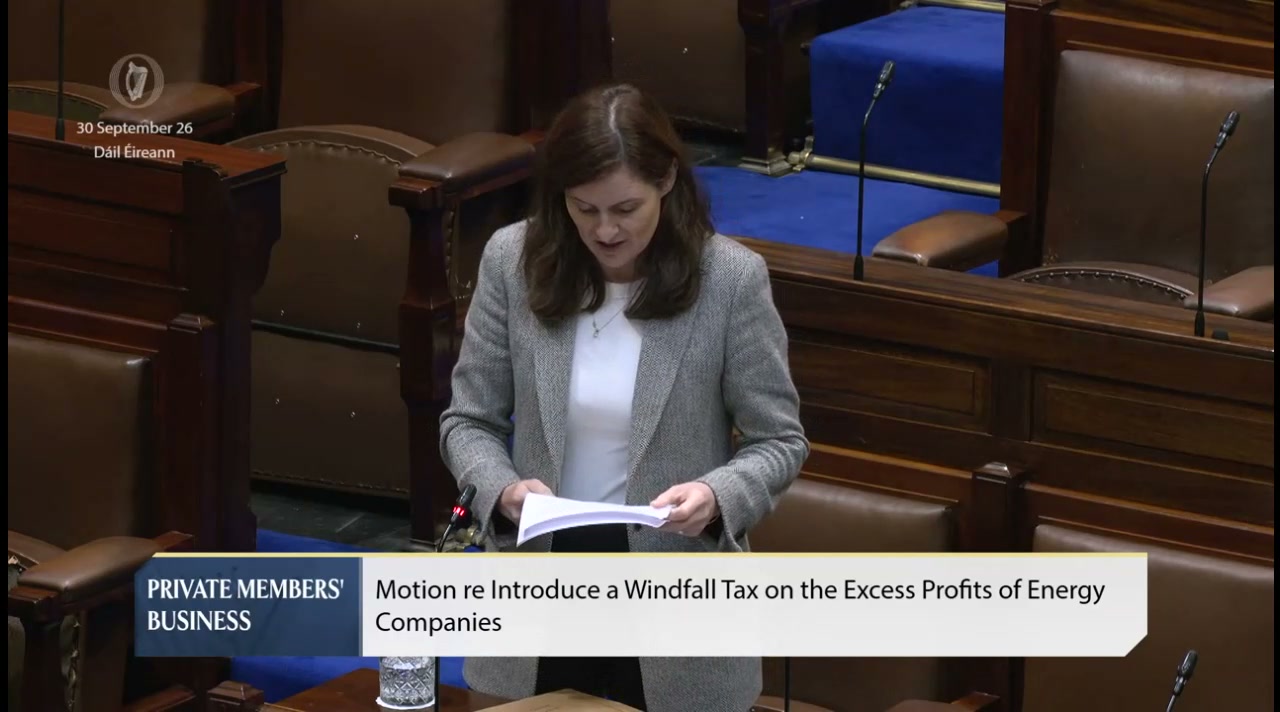
Ardagh said the Government’s energy measures were timely and necessary, and that support for vulnerable households would remain a priority. She concluded by reiterating the Government’s decision to reject the Social Democrats’ motion and put forward a counter-motion. Watch the recording to hear the full contribution.
Supports for households and businesses
Ardagh cited more than €1.4 billion in fuel supports, Budget 2026 measures on gas and electricity bills, and enhanced fuel allowance payments. She also highlighted supplier hardship supports and the Department of Social Protection’s additional needs payment for households struggling with fuel bills.
Retrofitting and renewable energy
The Government’s approach, she argued, includes expanding home energy upgrades and renewable energy. Ardagh referred to a €640 million allocation for residential and community grant schemes, new retrofit grants and increased applications for home energy upgrades and solar PV. She said reducing dependence on fossil fuels was the best long-term way to protect consumers from volatile energy prices.
Market revenue cap and EU action
The National Energy Affordability Task Force is preparing an Energy Affordability Action Plan, which is due to go to Government in the coming weeks. Ardagh said the plan would consider measures such as a market revenue cap, and that Ireland would engage with EU proposals for a potential windfall tax or levy on energy companies. She said coordinated EU action was preferable given the interconnected energy markets.
Government rejects Social Democrats’ motion
Ardagh said the Government’s energy measures were timely and necessary, and that support for vulnerable households would remain a priority. She concluded by reiterating the Government’s decision to reject the Social Democrats’ motion and put forward a counter-motion. Watch the recording to hear the full contribution.
We publish thousands of recordings to make Irish politics transparent and resistant to manipulation. Spotted an error? Report it — together we are building a reliable archive of Irish politics.
Other speeches
Tego samego dnia All speeches from this day →
Joanna Byrne
Joanna Byrne challenges FAI leadership over Israel fixtures
Mattie McGrath
Mattie McGrath Demands Urgent Eye Care for South Tipperary Children
Rose Conway-Walsh
Rose Conway-Walsh: ‘Nobody should be freezing in their homes’
Jen Cummins
Jen Cummins calls for fairer immigration and teacher pathways
Paul Murphy
Paul Murphy: Energy Profits and the Cost of Living Crisis
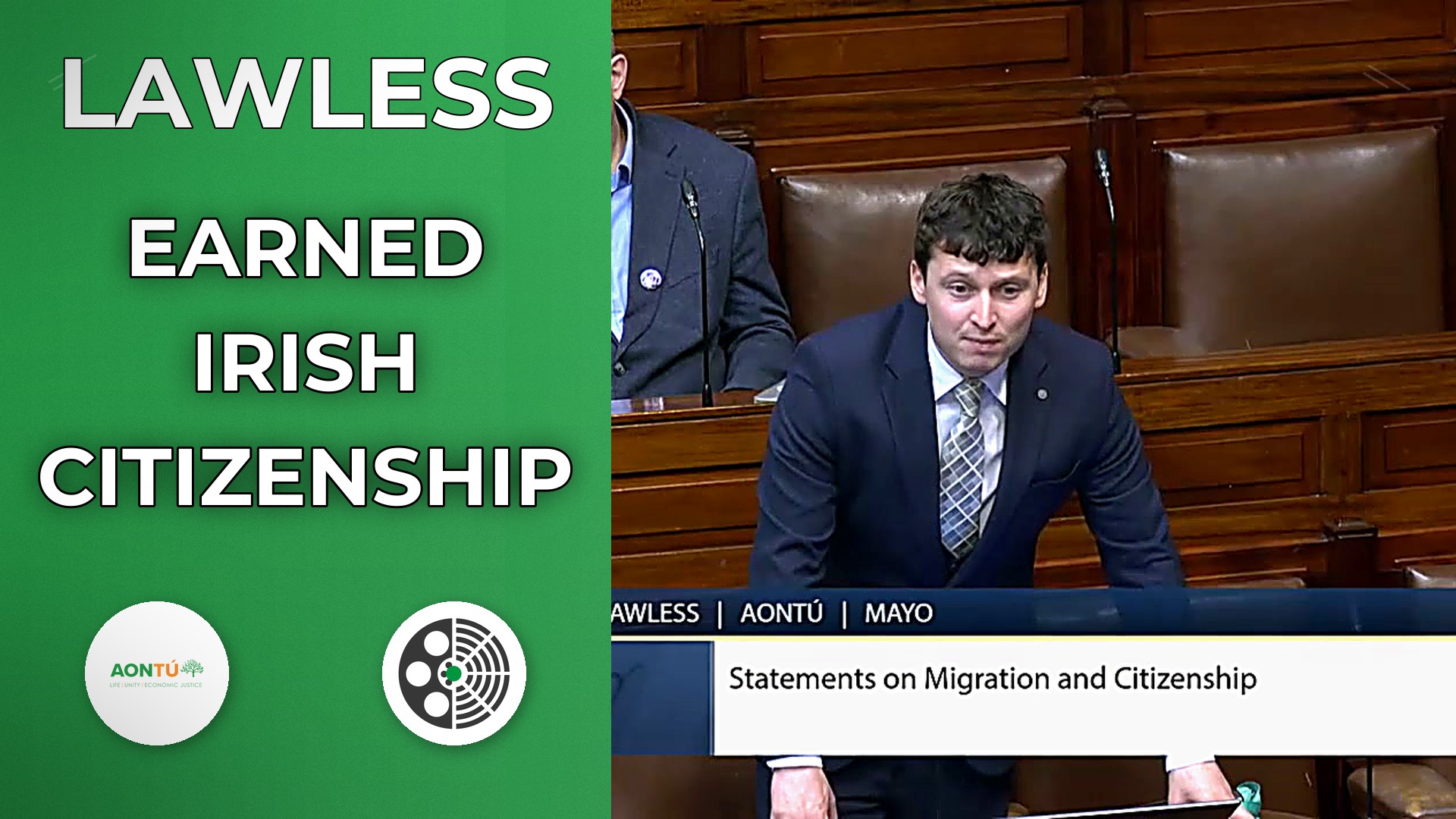
Paul Lawless
Paul Lawless Calls for Tighter Citizenship Rules
Transcript
Today, on behalf of the government,
on the Social Democrats' motion calling for the introduction
of a market revenue cap and a temporary solidarity
contribution on the excess profits of energy companies.
The government proposes to reject this motion
and put forward a counter-motion.
The conflict in the Middle East and in the Ukraine
have caused significant disruption
to the global energy markets that we all know.
The government recognizes the pressure
that resulting high energy prices
are placing on Irish consumers and businesses.
And we are actively monitoring the current geopolitical
situation and its impact on costs
to households and businesses.
Government understands that any price increase
can be a challenge for households and businesses.
As a result, we have been proactive
and introduced a series of measures to reduce fuel prices.
Further measures are under consideration
by the National Energy Affordability Task Force
and as part of the budgetary process.
Specifically on fuel, the package
of government support measures, which now totals over $1.4
billion, is helping to reduce the cost
burden at the petrol pump and assist key sectors,
such as agriculture and haulage, that
are critical to keeping our economy moving.
A range of measures in budget 2026
also supported households with energy costs,
including an extension until 2030 of the 9% VAT rate
currently applied to gas and electricity bills,
and enhanced social protection payments,
including an increase to the fuel allowance rate
and an expansion in the eligibility,
as well as a 400 euro income tax disregard for households
involved in micro generation, which
was extended for a further three years until the end of 2028.
The best way of insulating our economy and society
from fuel prices shocks is to reduce our dependence
on fossil fuels.
That is why we are investing record amounts in retrofitting,
both through part and fully funded schemes.
Budget 2026 also provided a record allocation
of $640 million for Sustainable Energy Authority of Ireland's
residential and community grant schemes,
allowing us to target 73,000 home energy upgrades this year
alone.
In January this year, we expanded and reformed
retrofitting schemes to ensure more homeowners can receive
grants.
The new measures included increased attic and wall
insulation supports, an increased grant of 12,500
for heat pump installation, and new grants
for windows and doors.
Simple upgrades like attic insulation, cavity wall,
or external wall insulation can reduce heating bills
by up to 230 euros annually.
A full home retrofit can lead to savings of 750 to 1,120
per year on energy costs.
Almost 89,000 applications have been processed up
to the end of August 2026.
As of yesterday, Dara O'Brien and government
has also approved an expanded range of grants for people,
including a new 2,000 euro boiler scrappage grant,
a new grant for battery storage, and expanded access
to certain measures for warmer home eligibility applicants,
and those in RAS tenancies.
These measures are all aimed at making
it easier and more accessible for people
to reduce their energy bills.
This compares to 41,100 applications
received to end August last year.
This is an 111% increase year on year
and follows changes to the schemes
that Minister O'Brien introduced earlier this year.
Capital expenditure of over $2 billion
has delivered over 287,000 home energy upgrades
from 2019 to August 2026, including
over 39,500 fully funded upgrades
for households at risk of energy poverty
under the warmer home scheme.
As of the end of August 2026, the domestic solar PV scheme
has supported over 21,000 homes to install solar PV panels
this year, and over 35,000 applications
have been received.
This is a 72% increase in applications year on year
and indicates that the scheme is working extremely well
and that householders are recognizing the benefit
of investing in solar PV.
A number of protections are in place
for customers experiencing difficulty
in paying their bills.
Anyone who is struggling with their bill
is strongly encouraged to engage with their supplier.
Suppliers have hardship funds and focus measures
in place for any customers who find themselves in difficulty
and will not disconnect customers who engage with them.
In addition, the Department of Social Protection
can also provide support through the additional needs payment
to help households meet expenses,
including those who face difficulty with fuel bills.
The National Energy Affordability Task Force,
which the Minister chairs, will have a key role
in identifying measures to enhance energy affordability.
This cross-government task force was established
to identify, assess, and implement measures
that will enhance energy affordability
for households and businesses while delivering
key renewable commitments and protecting security
of supply and economic stability.
The task force is working extensively
on the Energy Affordability Action Plan
to be submitted to government in the coming weeks.
This action plan will be focused on short, medium,
and longer-term measures to support households
and businesses to meet their energy costs.
The Energy Affordability Action Plan
includes the identification of measures
such as a market revenues cap,
which in a previous form were based
on the 2022 EU Council Regulation, 2022-185.
Ireland would engage constructively
on the development proposals from the EU Commission
on a potential EU-wide windfall tax or levy
if such proposals are brought forward,
as outlined earlier by Deputy Whitmore.
It continues to be the government's view
that tackling the energy crisis in a coordinated way
between EU and member states is preferable,
given the interconnectedness of the EU energy markets.
Governments across Europe are rightly attentive
to developments in energy markets
and their impact on household businesses
and the wider economy.
The Tánaiste and Minister for Finance
in the context of Ireland's presidency
of the Council of the EU
received a joint letter from six EU member state
finance ministers regarding a windfall levy
on exceptional profits made by oil companies
as a result of heightened prices
due to the conflict in the Middle East.
This item was put on the agenda by the Tánaiste
and discussed as part of the recent
Informa EcoFin in Dublin.
As a result, the Tánaiste requested
the European Commission to reflect on discussions
and report back on this issue
in the upcoming EcoFin meeting
that will take place in October.
To conclude, the government has introduced
substantial supports during the volatile period
back in April.
They are timely and necessary,
and we will very much continue
to monitor the situation closely.
Supporting those most vulnerable in society
must remain a priority,
and the government will continue to do that.
The best long-term approach for Ireland
is to insulate consumers from volatility
on international wholesale energy markets,
is to invest in energy efficiency and renewable energy.
Cutting our dependence on fossil fuels
and generating power from our own renewable resources
will ensure a cleaner, cheaper energy
into the long term.
I reiterate that the government rejects this motion,
and I propose a government counter-motion
that more accurately reflects the reality
of the situation.
Go raibh maith agat.